Who this is for
Ataraxia alongside therapy: reflection between appointments is most useful as a practical question, not as a label. This article examines private reflection between appointments while professional care keeps its own role.
This guide is for readers exploring « Ataraxia alongside therapy: reflection between appointments ». It considers private reflection between appointments while professional care keeps its own role without assuming that everyone in this situation has the same needs, resources or experience.
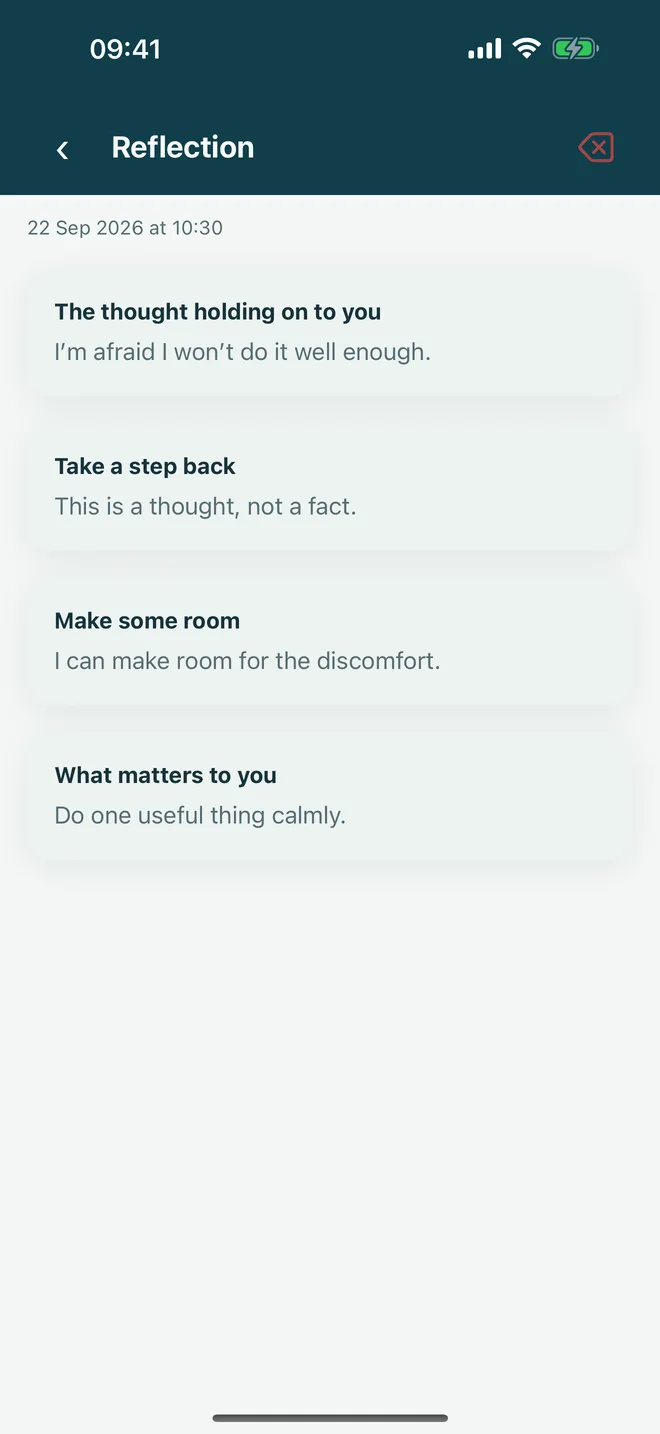
In “Ataraxia alongside therapy: reflection between appointments”, this screen provides a concrete product example: An ACT reflection that separates a difficult thought from a fact and returns to a chosen direction. The practice remains optional and does not replace the article’s guidance.
The everyday challenge
Private reflection between appointments while professional care keeps its own role. Pressure can narrow attention and turn a passing thought into a verdict. Context still matters: time, safety, health, relationships and material resources cannot be replaced by a reflective exercise.
Why a pause may help
The first cited source is used for the definition or context behind “Ataraxia alongside therapy: reflection between appointments”; it supports a bounded reading rather than a prediction about one person. [1]
The next source helps frame private reflection between appointments while professional care keeps its own role. Research design, population and setting limit how far any result can be transferred to a brief app practice. [2]
In Ataraxia, the relevant route is My thoughts: write the thought, mark it as a thought rather than an automatic fact, then return to a value and one chosen action.
Ataraxia in practice
Put “Ataraxia alongside therapy” into one concrete sequence
Situation. A demanding moment makes “Ataraxia alongside therapy: reflection between appointments” feel immediate: private reflection between appointments while professional care keeps its own role. An automatic interpretation starts to narrow the available choices.
- Open My thoughts and use only the part that fits this moment: write the thought, mark it as a thought rather than an automatic fact, then return to a value and one chosen action.
- Name what is here: Write the thought, feeling or pressure in plain words before deciding what it means.
- Separate thought from fact: Ask what is directly observable, what is an interpretation, and what information is still missing.
- Choose one small action: Turn a broad intention into a step that is specific, realistic and possible in the current context.
- Finish with one action under the user’s control: A useful next action can be asking for help, setting a boundary or bringing a concern to a qualified professional.
Ataraxia is a general wellbeing tool. It does not diagnose, treat or replace qualified care, and it cannot make unsafe circumstances safe. No therapist dashboard or automatic data sharing exists; you decide what to discuss.
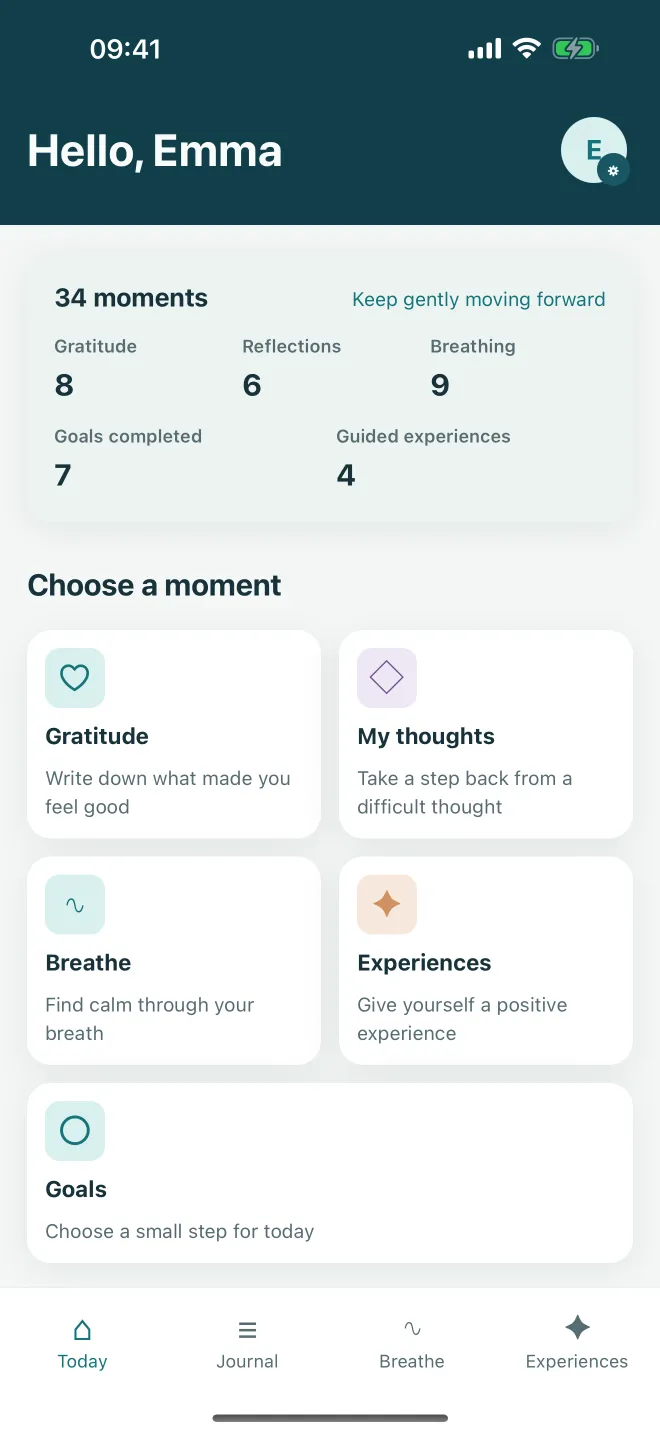
In “Ataraxia alongside therapy: reflection between appointments”, this screen provides a concrete product example: Cumulative completed moments without a streak, leaderboard or reset after an interruption. The practice remains optional and does not replace the article’s guidance.
Practical ways to use the approach
Use only what fits the moment. A useful practice should reduce friction, not become another standard to fail.
- Name what is here. Write the thought, feeling or pressure in plain words before deciding what it means.
- Separate thought from fact. Ask what is directly observable, what is an interpretation, and what information is still missing.
- Choose one small action. Turn a broad intention into a step that is specific, realistic and possible in the current context.
- Include support in the plan. A useful next action can be asking for help, setting a boundary or bringing a concern to a qualified professional.
The point is not to finish the whole problem. It is to make “Include support in the plan” concrete enough for the next moment.
What not to expect
Ataraxia is a general wellbeing tool. It does not diagnose, treat or replace qualified care, and it cannot make unsafe circumstances safe. No therapist dashboard or automatic data sharing exists; you decide what to discuss.
Educational and informational content only. It is not diagnosis, therapy or emergency care, and does not replace professional support.
One question to carry forward
What would one careful, useful next step look like when “Ataraxia alongside therapy: reflection between appointments” becomes relevant?
The point is not to finish the whole problem. It is to make “Name what is here” concrete enough for the next moment.
Sources and references
Prepared for Ataraxia using the cited sources. No professional credential or scientific board is claimed.
- Evidence reviewHayes, S. C.; Luoma, J. B.; Bond, F. W.; Masuda, A.; Lillis, J. (2006). “Acceptance and Commitment Therapy: Model, processes and outcomes.” Behaviour Research and Therapy, 44(1), 1–25. DOI: 10.1016/j.brat.2005.06.006. View source
- Evidence reviewGloster, A. T.; Walder, N.; Levin, M. E.; Twohig, M. P.; Karekla, M. (2020). “The empirical status of Acceptance and Commitment Therapy: A review of meta-analyses.” Journal of Contextual Behavioral Science, 18, 181–192. DOI: 10.1016/j.jcbs.2020.09.009. View source
- GuidanceWorld Health Organization (2024). “Clinical descriptions and diagnostic requirements for ICD-11 mental, behavioural and neurodevelopmental disorders.” World Health Organization. View source
Frequently asked questions
What is the practical point of “Ataraxia alongside therapy: reflection between appointments”?
It is to make one part of the situation observable and workable: private reflection between appointments while professional care keeps its own role. It is not a promise that the wider difficulty will disappear.
How could My thoughts support “Ataraxia alongside therapy”?
It offers a private structure to write the thought, mark it as a thought rather than an automatic fact, then return to a value and one chosen action. The practice stays optional and does not determine the right answer for the user.
What can Ataraxia not do about “Ataraxia alongside therapy”?
It cannot diagnose, treat, guarantee an outcome or make an unsafe situation safe. Qualified or emergency support remains important when the situation requires it.