Who this is for
The useful question behind “Ataraxia for couples: private reflection before shared conversation” is what can be noticed and chosen next. That requires looking at the space between an interpretation, a strong feeling and the next response.
This guide is for readers exploring « Ataraxia for couples: private reflection before shared conversation ». It considers the space between an interpretation, a strong feeling and the next response without assuming that everyone in this situation has the same needs, resources or experience.
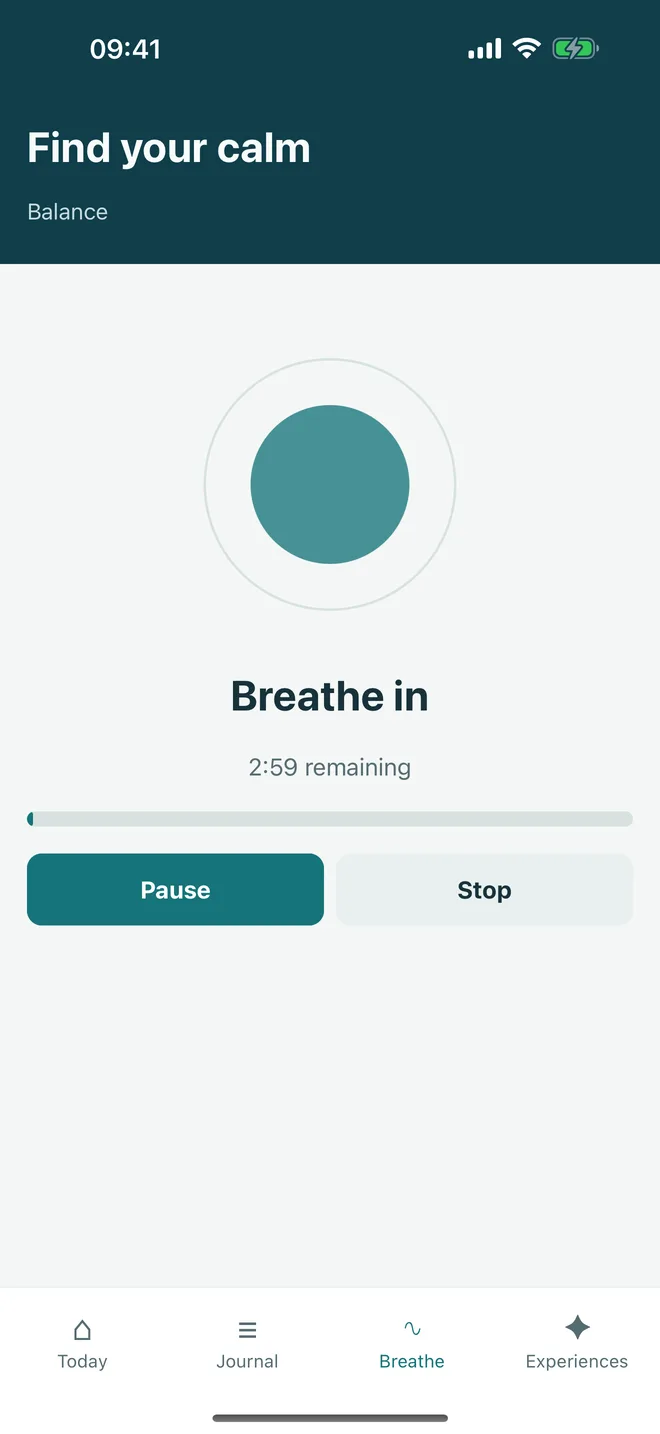
In “Ataraxia for couples: private reflection before shared conversation”, this screen provides a concrete product example: The recommended three-minute Balanced breathing rhythm with pause and stop controls. The practice remains optional and does not replace the article’s guidance.
The everyday challenge
The space between an interpretation, a strong feeling and the next response. Pressure can narrow attention and turn a passing thought into a verdict. Context still matters: time, safety, health, relationships and material resources cannot be replaced by a reflective exercise.
Why a pause may help
The first cited source is used for the definition or context behind “Ataraxia for couples: private reflection before shared conversation”; it supports a bounded reading rather than a prediction about one person. [1]
The next source helps frame the space between an interpretation, a strong feeling and the next response. Research design, population and setting limit how far any result can be transferred to a brief app practice. [2]
In Ataraxia, the relevant route is Breathing: start with the recommended three-minute Balanced rhythm; use Change only if another available rhythm fits better, and stop if the pause is unhelpful.
Ataraxia in practice
Put “Ataraxia for couples” into one concrete sequence
Situation. A person is pulled toward a quick conclusion while dealing with the space between an interpretation, a strong feeling and the next response. “Ataraxia for couples: private reflection before shared conversation” becomes a question about the next workable action.
- Open Breathing and use only the part that fits this moment: start with the recommended three-minute Balanced rhythm; use Change only if another available rhythm fits better, and stop if the pause is unhelpful.
- Create a brief pause: Take one optional slow breath or step away briefly before choosing a response. Breathing is never a test.
- Separate thought from fact: Ask what is directly observable, what is an interpretation, and what information is still missing.
- Use specific language: Replace global labels with a description of the event, behaviour or task that can actually be examined.
- Finish with one action under the user’s control: Choose a direction you want to embody even when certainty or comfort is unavailable.
Ataraxia is a general wellbeing tool. It does not diagnose, treat or replace qualified care, and it cannot make unsafe circumstances safe. A pause is not a reason to reconcile or remain in an unsafe relationship.
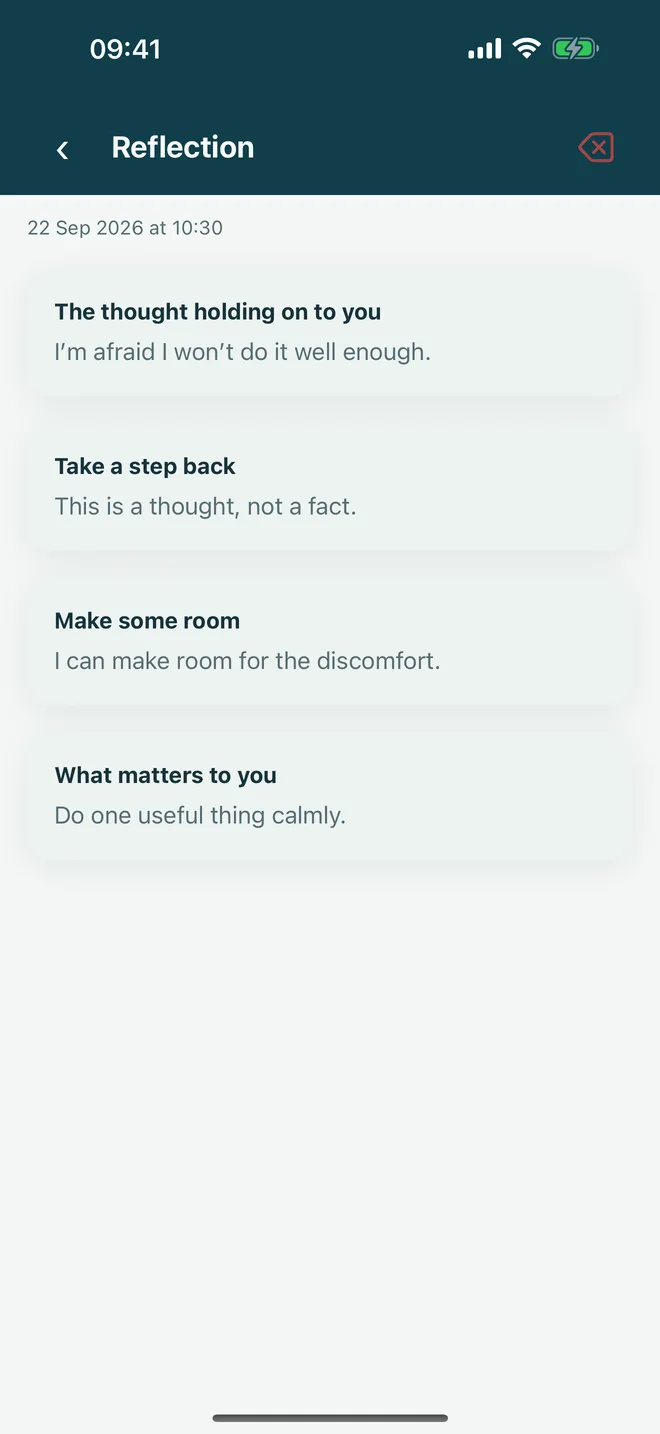
In “Ataraxia for couples: private reflection before shared conversation”, this screen provides a concrete product example: An ACT reflection that separates a difficult thought from a fact and returns to a chosen direction. The practice remains optional and does not replace the article’s guidance.
Practical ways to use the approach
Use only what fits the moment. A useful practice should reduce friction, not become another standard to fail.
- Create a brief pause. Take one optional slow breath or step away briefly before choosing a response. Breathing is never a test.
- Separate thought from fact. Ask what is directly observable, what is an interpretation, and what information is still missing.
- Use specific language. Replace global labels with a description of the event, behaviour or task that can actually be examined.
- Return to what matters. Choose a direction you want to embody even when certainty or comfort is unavailable.
The point is not to finish the whole problem. It is to make “Return to what matters” concrete enough for the next moment.
What not to expect
Ataraxia is a general wellbeing tool. It does not diagnose, treat or replace qualified care, and it cannot make unsafe circumstances safe. A pause is not a reason to reconcile or remain in an unsafe relationship.
Educational and informational content only. It is not diagnosis, therapy or emergency care, and does not replace professional support.
One question to carry forward
What would one careful, useful next step look like when “Ataraxia for couples: private reflection before shared conversation” becomes relevant?
The point is not to finish the whole problem. It is to make “Create a brief pause” concrete enough for the next moment.
Sources and references
Prepared for Ataraxia using the cited sources. No professional credential or scientific board is claimed.
- Evidence reviewOverall, N. C.; McNulty, J. K. (2017). “What type of communication during conflict is beneficial for intimate relationships?.” Current Opinion in Psychology, 13, 1–5. DOI: 10.1016/j.copsyc.2016.03.002. View source
- Evidence reviewGross, J. J. (1998). “The emerging field of emotion regulation: An integrative review.” Review of General Psychology, 2(3), 271–299. DOI: 10.1037/1089-2680.2.3.271. View source
- Evidence reviewHayes, S. C.; Luoma, J. B.; Bond, F. W.; Masuda, A.; Lillis, J. (2006). “Acceptance and Commitment Therapy: Model, processes and outcomes.” Behaviour Research and Therapy, 44(1), 1–25. DOI: 10.1016/j.brat.2005.06.006. View source
Frequently asked questions
What is the practical point of “Ataraxia for couples: private reflection before shared conversation”?
It is to make one part of the situation observable and workable: the space between an interpretation, a strong feeling and the next response. It is not a promise that the wider difficulty will disappear.
How could Breathing support “Ataraxia for couples”?
It offers a private structure to start with the recommended three-minute Balanced rhythm; use Change only if another available rhythm fits better, and stop if the pause is unhelpful. The practice stays optional and does not determine the right answer for the user.
What can Ataraxia not do about “Ataraxia for couples”?
It cannot diagnose, treat, guarantee an outcome or make an unsafe situation safe. Qualified or emergency support remains important when the situation requires it.